Women’s History Month 2008

The Women’s Studies Program of Georgetown College invites you to honor the history and contributions of notable and ordinary women, by participating in the events scheduled for our Seventh Annual Celebration of National Women’s History Month:

“Women’s Art: Women’s Vision”

February 14

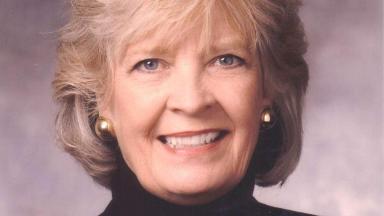
Jane Gentry Vance, Kentucky Poet Laureate 2007-08, will discuss her life and her poetry.
11 a.m., John L. Hill Chapel.
Jo Shoop Women’s Symposium. CEP credit.

February 28

Art Opening: “The Metamorphosis of Identity: Nina Buxenbaum, Gaela Erwin, and Chris Twomey.”
5-7: p.m., Anne Wright Wilson Fine Arts Gallery. (Exhibit runs through March 30).
Art Department.

March 4

Betsy B. Smith will present a Chautauqua performance as Emilie Todd Helm.
11 a.m., John L. Hill Chapel.
Jo Shoop Women’s Symposium. CEP credit.

March 10

Gaela Erwin will talk about her artwork in the exhibit “The Metamorphosis of Identity.”
5 p.m., Anne Wright Wilson Fine Arts Gallery.
Art Department. CEP credit.

March 27

“Motherland Afghanistan.” Film showing and discussion about the dire state of maternal healthcare in Afghanistan.
6 p.m., Hall of Fame Room, Cralle Student Center.
Sponsored by Women’s Studies. CEP credit.

April 7

“Angel of Memory,” The Core Ensemble. Four true stories of strong women facing the tumultuous events that span the 20th Century.
8 p.m., John L. Hill Chapel.
Faust Artist Series. CEP credit.

Month-long Events

  • Feb.28-March 30 special exhibit in the Art Gallery.
  • “Women of Vision” display in the LRC.
  • Women’s History Month display in The Store.

For changes, additions, visit the master calendar. For more information contact Gretchen E. Ziegenhals, Director of The Women’s Studies Program at Georgetown College, 502-863-8398.

Mathematics’ Will Harris Wins Coveted Curry Award; Four Inducted into GC Hall of Fame on Founders’ Day

The annual Founders’ Day Convocation on Tuesday (Jan. 29) was the perfect blend of the old and the new at Georgetown College.

Andrea Chadwick, a junior Biology major/Chemistry minor, made her public debut as the new SGA President and introduced her executive council from the John L. Hill Chapel stage; and Dr. Eric Fruge, Director of the Capital Campaign, gave an entertaining keynote presentation of some of the recent discoveries he’s unearthed about the early days of Georgetown College (watch for more in future Insights).

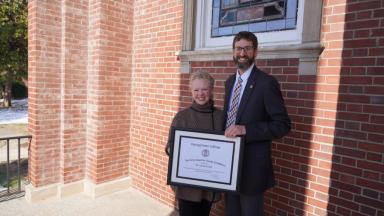
dr harris awardedThe coveted Curry Award for Faculty Excellence this year went to Dr. Will Harris, an associate professor of Mathematics and coordinator of the math program. Provost Rosemary Allen – here presenting the award along with President Bill Crouch – praised Harris, a Georgetown teacher for 16 years, as a scholar and campus leader – especially for his work on the faculty and curriculum committees during challenging times.

The award is given in the names of Dr. Gwen Curry – who was proudly in attendance – and her late husband, Dr. Ralph Curry, two long-time leaders of the College faculty and former chairs of the English Department.

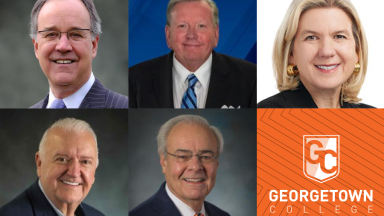
And, as has been the tradition since 1993, four were inducted into the Hall of Fame – an Air Force general, a journalist/pastor, a bank president, and a professor. Jesse Auton, Alexander Warren LaRue, and Rhodes Burch Thomas were all Georgetown College graduates, while Jonathan Farnam was a professor of the natural sciences. All four men possessed the desire to better their community and world.

  • Auton rose to the rank of Brigadier General after serving as a White House aide to President Franklin Roosevelt and then flying missions in both World War II and the Cold War.
  • LaRue, who was in the first graduating class at Georgetown (1842), pastured Kentucky churches in Louisville, Bracken County, Harrodsburg, Stanford, Georgetown and Christian County. He was also an associate editor The Baptist Banner, which would become The Western Recorder.
  • Thomas, Class of 1882, became president of Georgetown’s Farmers Bank and Trust in 1911 and served as chief executive until ’24. He also served 18 years on the College’s board of trustees, five as chairman. He established the Danford Thomas Lecture Series in memory of his father, a longtime professor of languages here.
  • Farnam was named a professor of natural sciences here in 1839; in 1846 he founded Farnam the Georgetown Female Seminary. Soon after the Civil War, women from the seminary were integrated into the College’s student body.

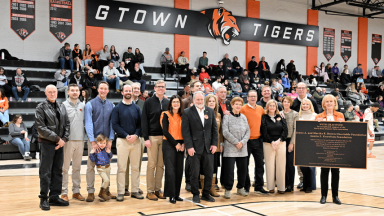
Descendants of Auton may have set a Georgetown Hall of Fame record with 23 attendees at Tuesday’s ceremony and luncheon. Here, 21 relatives posed with President Crouch in Hill Chapel. Descendants of Thomas had a big showing as well with 11 – including latest legacy Gentry Hambrick, a sophomore from Georgetown, in the leopard print dress.

Inductees – outstanding alumni and friends who have made distinctive contributions to the College – are memorialized by marble plaques placed in their honor in the Hall of Fame Room of Cralle Student Center. For more on each, visit the release: Four Inducted into GC Hall of Fame.

Four Inducted into GC Hall of Fame

January 29, 2008 – Four new members (now deceased) were honored by inclusion in the Georgetown College Hall of Fame during the Founder’s Day Convocation at John L. Chapel. Inductees – outstanding alumni and friends who have made distinctive contributions to the College – are memorialized by marble plaques placed in their honor in the Hall of Fame Room of Cralle Student Center.

Below is the full text that was read to the campus community and family members of two of the honorees. The 23 relatives who came to the ceremony in honor of Brigadier General Jesse Auton is thought to be the largest number of family members to attend since the Hall of Fame was established in 1993.

Rhodes Burch Thomas

Rhodes Burch Thomas, Class of 1882, was the son of Danford Thomas, Georgetown College’s first librarian (1846-1880) and professor of ancient languages and literature. In 1920, in memory of his father, Rhodes Thomas established the Danford Thomas Lecture Foundation Fund which continues to bring many distinguished speakers to Georgetown College’s campus. Speakers have included Admiral Richard Byrd, the first explorer of the Antarctic, Daniel Schorr, renowned broadcast journalist, David Brinkley, co-anchor of the evening Huntley-Brinkley Report for NBC News from 1956-1970, and Jennifer Ludden of National Public Radio. Rhodes Burch Thomas served eighteen years on his alma mater’s board of trustees and was its Chair the last five years, from 1908 to 1913. During Thomas’ tenure as trustee, Rucker Hall was built, three Georgetown College students attended Oxford University as Rhodes Scholars, the Women’s Association was formed to raise scholarships for women, the first full time athletic coach was hired, and John L. Hill was named the college’s first Dean.

Rhodes Thomas began managing his father’s 561-acre farm while in college, and then he began farming the land on his own after his father’s death in 1882. Farming was his principal vocation. In 1906, Thomas was an organizer of the Tobacco Grower’s Association of Kentucky. He later served as president of Farmers Bank and Trust Co from 1911 to 1924. He was a member of many other community organizations, helping to establish the John Graves Ford Memorial Hospital and the Georgetown Cemetery. Rhodes Thomas died in 1933.

Thomas’s descendants continue his legacy at Georgetown College. His grandson, Horace Thomas Hambrick, was a 1949 alumnus and is professor emeritus of history, and Gentry Hambrick, Thomas’ great-great granddaughter, is now a student.

Alexander Warren LaRue

Alexander Warren LaRue was an instrumental leader in establishing a newspaper for Kentucky Baptists.

In the first third of the nineteenth century, many Baptist groups vied for preeminence. To advocate their doctrinal positions and ideas for organizing, they attempted to begin newspapers that appealed to Kentucky Baptists generally, but they all failed. It was not until the 1830s that Kentucky Baptists founded a statewide organization and created the environment to establish a newspaper for Kentucky Baptists.

Alexander Warren LaRue was born into a prominent Baptist family in 1819 in Hardin County, Kentucky. His wife, Malvina Craig, was granddaughter of Lewis Craig, a renowned Baptist preacher in early Kentucky and a brother to Elijah Craig. When LaRue was licensed to preach in 1838 at Severn’s Valley Baptist Church, in Elizabethtown, Kentucky, the General Association of Baptists in Kentucky had been formed the previous year. The Baptist Banner had been publishing out of Louisville, in one form or another, since 1834. However, LaRue did not intend to be a journalist, but a preacher. He entered the new Baptist college at Georgetown in 1839 to begin his studies for the ministry. He graduated in Georgetown College’s first commencement in 1842.

After graduation, LaRue pastored the Baptist church in Flemingsburg, Kentucky, for seven years until 1849, when he went to Louisville to co-edit, and later manage, the Baptist Banner, a semi-monthly newspaper for Kentucky Baptists and the surrounding region. In 1851, the Banner was renamed the Western Recorder with LaRue continuing as co-editor. The new newspaper was enlarged, and it became a weekly publication. The Western Recorder continues to be an independent voice for Kentucky Baptists today.

After two years as an editor of the Western Recorder, Alexander Warren LaRue felt a greater call to preaching, and he gave up his editorial duties to pastor churches in Louisville, in Jefferson County; Harrodsburg, in Mercer County; Georgetown, in Scott County; Stanford, in Lincoln County; and Salem, in Christian County, continuing his influence throughout the state. He died in 1864 during his last pastorate. The funeral was held at Walnut Street Baptist Church, Louisville, and he was buried in Cave Hill Cemetery.

Jesse Auton

Combat pilot, aide to President Franklin Roosevelt, and general, Jesse Auton served in many significant capacities during his career in the fledgling United States Air Force.

A 1927 alumnus of Georgetown College, Auton began his career in military aviation in 1928, by enlisting in the U.S. Army Air Service, when the nation’s air force was part of the Army. Following pilot training in Texas, his advancement was meteoric. After being commissioned a 2nd Lieutenant in 1930, Auton served several assignments in Michigan and California. In 1934, he became an aide and pilot for the commander of the 2nd Army Corps, which gave Auton the opportunity to command the Air Service color guard during the funeral of Will Rogers. In early 1936, he began serving as a White House aide under President Franklin Roosevelt and as aide and pilot for Assistant Secretary of War, Louis Johnson.

When the United States entered World War II, Auton was given key assignments to prepare for the arrival of the American air force in Europe. He was an observer in England and Ireland to survey potential sites for U.S. air bases. In the United States, Auton commanded two fighter groups, one in Florida and then one in California. The San Francisco Air Defense Wing was transformed into an overseas fighter wing, and it became the first operational U.S. fighter wing in Europe. As wing commander, Auton directed five fighter groups and one emergency rescue squadron. In addition to his duties as commander, he actively flew combat missions until the end of his command in November 1945.

During the Cold War, Auton held a number of command positions, including wing commander of the 313th Troop Carrier Wing, which led in hauling coal into Berlin during the Berlin Airlift of 1948-49.

Auton’s last assignment was at the Strategic Air Command headquarters in Omaha, Nebraska, serving under General Curtis Lemay. In late 1951, he was given the permanent rank of brigadier general with the position of director of fighter support operations. (He had held the rank temporarily during World War II.) General Jesse Auton was killed in a plane crash in 1952. He was buried at Arlington National Cemetery with full military honors.

Johnathan Everett Farnam

Jonathan Everett Farnam pioneered higher education for women during his forty-eight years teaching at Georgetown College.

Georgetown College was in turmoil when its trustees called Rockwood Giddings in 1839 as president to save the college. Giddings made his acceptance conditional, in part, on Jonathan Everett Farnam coming with him. Both men lived in Shelbyville, Kentucky: Giddings as pastor of the Baptist church and Farnam as tutor at Shelby College. Jonathan Everett Farnam arrived at Georgetown College in 1839 with Rockwood Giddings.

Farnam, born in 1809, in Attleboro, Massachusetts, had known Giddings when both were students at Waterville College (now Colby University) in Maine. He tutored for two years at his alma mater after receiving his degree in 1833. He studied law in Providence, Rhode Island, and Cincinnati, Ohio. In 1835, he accepted a position at Shelby College.

At Georgetown, Farnam began teaching the natural sciences in 1839. With encouragement from Giddings’ successor, President Howard Malcom, Farnam started the Georgetown Female Seminary in 1845. The women were taught virtually the same curriculum as the all male college because the college’s faculty also taught at the seminary. In 1865, the seminary building burned and Professor J. J. Rucker reopened the seminary in his home. Farnam resigned as principal, but continued to teach the Natural Sciences. Unfortunately, Farnam died in 1890, three years before the first women received degrees from Georgetown College.

For You, Valentine: Dinner & Joey Dee Show

January 24, 2008

The Pawling Heritage Society of Georgetown College has a new twist for their annual open-to-the-public “Valentine’s event” – The Peppermint Twist – on Sunday, February 10.

Those “young” enough to remember the 1961 chart-topping song by Joey Dee and The Starliters will be twisting every which-way to hear the new version of the group following a delectable dinner in the College’s Hall of Fame Room in the Cralle Student Center. Dinner and fellowship starts at 6 p.m., followed by the show next door in John L. Hill Chapel at 8 p.m.

The New Joey Dee and The Starliters Show is part of the College’s Foust Artist Series. For those interested in just the concert, tickets may be purchased at the door for $10 (or $8 for seniors; $5 for non-Georgetown students).

But, your best deal is the $20 package for dinner and show. Make reservations online at or call (502) 863-8041. You may also reserve concert-only tickets at that phone number as well.

Joey, born Joseph DiNicola in Passaic, NY (1940), and the original group shot to stardom after what was supposed to be just a weekend gig in 1960 at New York City’s Peppermint Lounge. But, it went so well they became the house band for more than a year.

Also in 1961, Joey and the band filmed the Paramount Pictures movie, “Hey, Let’s Twist,” a tribute to the by-then famous lounge. In ’62, they starred in a second film, “Two Tickets to Paris.” The following year, Joey Dee recorded the album Dance, Dance, Dance featuring The nettes as his backup group.

Now, Joey Dee and The tarliters play venues from Florida to Las Vegas, presenting over 100 concerts a year. In 2001, the group was featured on a PBS special – “Rock, Rhythm and Doo-Wop.”

For more information on all arts events at the College, visit our master calendar.

Music Faculty Recital Showcase Has Special Treat

The annual Georgetown College Music Department Faculty Showcase Recital is always an entertaining afternoon. But, this Sunday (Jan. 27) at 3 p.m. is the public’s chance to hear a special piece by department chair Sonny Burnette on saxophone accompanied by professor emeritus Daniel Tilford on the new Johannus digital pipe organ in John L. Hill Chapel.

According to Burnette, the Eugene Bozza “Aria” is a work for alto saxophone and piano written in the style of Bach. “I think it is even more successful on organ than on piano,” said Dr. Burnette of the wrinkle Tilford brings to this performance.

“I love the organ timbres that Dr. Tilford has chosen,” Burnette added. “The two instruments blend extremely well together. We’ve been having a ball rehearsing this truly beautiful ballad.”

The other featured performers include: Dr. H.M. Lewis, trumpet; Dr. Peter LaRue, trombone; Dr. John Campbell, tenor; Dr. Heather Winter Hunnicutt, soprano; Dr. Mami Hayashida, piano; and Lori Smith on piano. They’ll perform music of Bachelet, Donizetti, Goedicke, Gounod, Graundahl and Schubert.

The organ – named for the Daniel Tilford and Mildred Osborne families – was dedicated during Opening Convocation in September. It was crafted to Tilford’s specifications by Johannus Church Organs, a company in the Netherlands that manufactures digital pipe organs.

The concert is free and open to the public.