Annual Pastors Conference a Fresh Experience

A preacher from London, England and a church planter from Bloomington, Indiana headline the annual Georgetown College Pastors’ Conference, scheduled April 16-18, at the College’s Thomas & King Leadership & Conference Center.

“It is always eight days after Easter – a date that many pastors mark on their calendars and look forward to,” said planner Dwight A. Moody, Dean of the Chapel. “This conference helps ministers find fresh energy and enthusiasm for our calling.
“And, this year we are uniquely blessed to feature an international pastor and a female church leader,” Moody added.
Simon Perry is the young pastor of Bloomsbury Central Baptist Church in London. The Britisher, who holds a PhD from Cambridge, will lead the Bible Study on Luke chapter four, with the theme, “Temptation and the Ministry.”

Lesley Kreiger left the security of a First Baptist Church staff to launch a Generation X church plant in Bloomington, Indiana. She is a graduate of Duke Divinity School. She will speak at the Tuesday evening banquet, taking the theme “Paul, Penguins and Project X.”

Krieger, 28, served in a traditional church for five, mostly satisfying years. “But, I needed to make church engaging to people who didn’t have a positive church experience in their lives,” said Krieger, who is the lead pastor for this new congregation that has attracted since September more than 50 people with a mix of previously unchurched and many who had left the church years ago. One way she has been able to reach them with relevant messages is by meeting on Saturday nights in a sports complex.

“I’m hoping conference participants from traditional churches will like my enthusiasm as a new church planter and ask me to share more about ways to reach out to the unchurched in their communities,” she said.
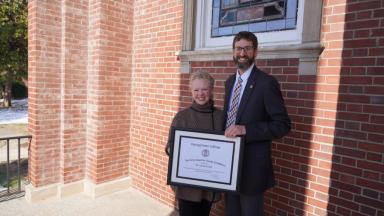
The banquet will also feature the presentation of the annual award for lifetime achievement in ministry, the Ken Chafin Award. The honoree is 1941 Georgetown graduate Ira McMillan. McMillan served for many years in Kentucky and Ohio as pastor, church planter, and administrator.

Other speakers include Texas preacher Joel Gregory who will preach a sermon entitled “A Hole in the Wall.”
Dr. John Durham, a retired Hebrew and Scripture scholar now living in Virginia, will lead two sessions on “Art and Exegesis” based on his recent best-selling book “Rembrandt and the Bible.”

Two special events highlight this year’s conference. On Tuesday, Ms. Jean Smith, of the Lilly Endowment of Indianapolis, will lead a seminar on the Clergy Renewal Program. Each year the Endowment gives sabbatical grants of as much as $45,000 to several hundred ministers. Ms. Smith administers this program and is eager to see more Baptist ministers apply for the sabbatical funds.

On Tuesday evening, the Conference will host an Authors’ Reception and Book Signing. It will feature conference speakers Durham and Gregory, Georgetown personnel Eric Fruge, Norm Wirzba and Dwight Moody, as well as some attendees, such as Tim Simpson, on the staff of First Baptist Church of Frankfort.

The conference center is located at 101 Stadium Drive next to Toyota Stadium. Additional information and registration is available online at www.georgetowncollege.edu/ministry, or contact Robbi Barber by phone or e-mail: 502-863-7047 or robbi_barber@georgetowncollege.edu.

Georgetown is a faith-based, residential, co-educational college defined by academic excellence in the liberal arts that teaches students to think, to lead, and to serve with balance and respect as demonstrated and modeled by Christian character. Historically Baptist affiliated, Georgetown College is nationally ranked by U.S. News and World Report and has an undergraduate enrollment of 1,406 students, the largest in its history.

Best Not Question Coach Burch on Poetry, Peace or Terrorism; Georgetown English Professor to Deliver Cawthorne Lecture

Barbara Burch has plenty to say about poetry’s relevance to peace in today’s world. And, you’re invited to hear her artful ways of putting it at the annual Cawthorne Lecture at 11 a.m. Tuesday (Feb. 27) in John L. Hill Chapel.

Dr.Burch, a professor of English and coach of Georgetown College’s standout Academic Team, has the honor of delivering the lecture as a result of her being recognized with The 2006 Cawthorne Excellence in Teaching Award at commencement last May. The award was established by the late couple, Don B. and Chris Kerr Cawthorne, in 1988 as a way to acknowledge a faculty member who has demonstrated a dedication to students and a gift for excellent teaching.

During her presentation, “Whatever You Say, Say Nothing: The Art of Poetry and the Problem of Terrorism in Northern Ireland,” Burch will talk about three well-known poets who “came of age and wrote poetry during the political turmoil that gripped Northern Ireland during the second half of the twentieth century.

Throughout her study of Seamus Heaney, Ciaran Carson and Michael Longley, Burch said she has analyzed how the poets wrote about the “horrors of civil strife and terrorism without asserting their personal political beliefs.”

“My belief is that these poets, along with many others, created art that has played a subtle but important part of the peace and reconciliation process in Northern Ireland. I hope to convey the message that poetry matters outside of the classroom and that it is relevant to contemporary threats to world stability and peace,” Burch said.

Both of Burch’s academic teams are defending Kentucky College Quick Recall League champions. The varsity team has won all three KCQRL tournaments this season and the junior varsity has won two of three KCQRL tournaments.

Most recently, the varsity squad won first place in Division II of Sword Bowl with an 11-0 record. The Sword Bowl is a tournament held at the University of Tennessee—Chattanooga in which teams from around the southeast compete, Burch said, naming Florida State University and the University of Louisville as just two of the teams Georgetown beat.

“The Academic Team is doing great. I can’t remember the last time I’ve enjoyed coaching the team so much,” Burch said. This year’s “rookies” include two members of the quick recall team that won the Governor’s Cup competition last year, Tyler Frailie of Ashland and Rebecca Sicking of Russell. We also have three additional promising freshmen, Jacob Price of Somerset, Heather Scott of Fort Thomas and Amy Hall of Louisa.

NPR Correspondent to Reveal Why Kentucky is a ‘Border State’

Jennifer LuddenMost Kentuckians are probably aware of an influx of people from south of the United States border who have come to work on tobacco or horse farms. But, few residents would consider the Commonwealth a “border state.”

Jennifer Ludden, a national desk correspondent with National Public Radio, may change that thinking of those present for the annual Danford Thomas Lecture at Georgetown College. Her talk, “The New Immigration Debate: Why Every State’s a Border State,” is free and open to the public at 4 p.m., Tuesday (Feb. 20) in John L. Hill Chapel.

Why should Kentuckians care about what’s happening with immigration? Ludden, whose pieces can be heard on all NPR News programs, including All Things Considered, Morning Edition, and Weekend Edition, wrote in an e-mail Wednesday: “The immigration debate isn’t just about immigrants. It’s about the national economy, the rule of law, human rights, and – really – who we are and will become as a nation.”

Ludden, who covers immigration and immigrant issues, filing stories that reflect the changing demography of the U.S., continued: “In 1965 President Lyndon Johnson signed what is the basis of our national immigration law today, declaring that it would have no great impact. In fact, he was wrong. That law led to a sharp rise in immigration and to the multicultural society we see today, despite administration predictions that neither of those things would happen.”

Previously Ludden covered the Middle East for NPR, reporting on the Israeli-Palestinian conflict and the collapse of the decade-long Oslo peace process. In between breaking news, she also traveled from Egypt to Iran, reporting on cultural issues such as the dying tradition of storytellers in Syria or the emergence of Persian pop music in Iran.

Before taking up the Middle East beat, Ludden was based in Paris, reporting on France as well as traveling to Turkey, Kuwait, and India, among other places. From 1995 to 1997, Ludden covered West and Central Africa for NPR, coverage that included chronicling the devastating effects of civil war in Liberia and Sierra Leone. Her reports from Mali, Ghana, the Ivory Coast, and elsewhere also provided slices of everyday life in a region that is little covered by the international media.

Ludden won the Robert F. Kennedy award for her coverage of the fall of Zaire’s Mobutu Sese Seko and the rebellion of Laurent Kabila (who changed the country’s name to the Democratic Republic of Congo). Ludden was also part of the NPR team which won two awards for coverage of Kosovo in 1999: the Overseas Press Club Lowell Thomas Award and the Society of Professional Journalists’ Sigma Delta Chi Award for Excellence in Journalism.

In the Q-and-A below, Jennifer Ludden gives insight on some of the international stories and countries she has covered:

Question: Georgetown College has a partnership with the University of Kentucky’s Patterson School for Diplomacy and International Commerce, and student team (called Project Compassion) that is involved with the U.N.’s World Food Programme and is a key player in a new, grassroots student organization, Universities Fighting World Hunger; we also have one interdisciplinary major called Commerce, Language & Culture and just announced another called Security Studies. What would you tell these students, who are beginning to study and understand what it might take to be a significant player in the global marketplace or the world humanitarian scene?

Answer: The U.S. immigrant population very much reflects what’s happening in the rest of the world. When people speak about getting to the “root causes” of immigration, they mean the poverty, war and other upheavals that drive people from their homes and lead them to seek refuge (or a better life) in Western nations. The U.S. is also far from alone in confronting a polarized and emotional debate over immigration these days. Many European countries and Australia are going through the same thing, as people in poorer African and Asian countries flock to their shores.

Q: Georgetown College is a Baptist-affiliated institution that sends a number of students on missions abroad. What would you have THEM know?

A: (see above!)

Q: What would you hope students who are NOT involved in any of these programs would come away with?

A: The main problem is that our current immigration system is broken. The government has simply not funded and not enforced its immigration system for several decades. While it’s true that millions of those here now “broke the law” by entering illegally, it’s also true that they’ve come with the near-certain knowledge that U.S business will give them a job. Successive administrations, Congresses, and industry are all complicit in the immigration problem today, yet it is largely the undocumented workers themselves who get the blame.

Q: Since these current students have been in college, the War in Iraq has been center stage and the Israeli-Palestinian conflict has unfortunately taken a distant back seat….almost a footnote most nights (if at all) on the nightly network news. So….based on your experience reporting on that Middle Eastern conflict, what should our students keep in mind?

A: While the Israeli-Palestinian conflict has fallen from our headlines, it’s still very much an issue across the Middle East. The Israeli barrier – while highly controversial – has seemed to reduce the number of terror attacks inside Israel. But the situation in the Gaza Strip and West Bank has only worsened since my time there, with open warfare between Hamas and forces of the Palestinian Authority. While it’s easy to dismiss “peace talks” and diplomacy that can drag on for years with marginal benefits, it sure seems to produce better results than the virtual stonewalling of the Bush administration.

Q: We see that you have reported on the emergence of Persian pop music in Iran. Given that the current administration is eyeing Iran as a threat….and is accusing Iran of supporting the insurgents in Iraq ..do you have any insights on Iran?

A: Iran is a much more complex country than the sound-bites and actions of its president Ahmedinejad would suggest. When I was visiting there between 1999 and 2001 I always thought of it as two countries, really – the hardliners and the reformers. There are many who disagree with the conservative religious mullahs who are in charge, but they have little public voice. It’s only been two and a half decades since the Islamic revolution, and underneath those long black chadors and beards is a vibrant, opinionated population, many of whom have great admiration for the United States. Geographically and militarily speaking, Iran is also a completely different story than Iraq, whose state forces faded away in the face of the U.S. “cakewalk” to Baghdad. It’s a grave mistake to think the U.S. could prevail in a military assault on Iran.

Q: From your exposure to Persian pop music, do you have a favorite group or singer? Any that could pop up on OUR charts, if given the opportunity?

A: Houman Javid was a delightful young artist who’d just had his first album recorded when I interviewed him. I have no idea if his work is available in the U.S., but he does a mean imitation of Elvis!

Danford Thomas was a professor and a part of a family with lengthy ties Georgetown College, including several generations of faculty, most recently Dr. Horace Hambrick, emeritus professor of history. The lectureship was endowed in 1920, and past speakers have included Commander Richard Byrd, Daniel Schorer, Justice William O. Douglas, Congressman Brooks Hays, Elton Trueblood, Sam Donaldson, Alex Haley, Edwin Newman, and John Esposito.

Photo by Debbia Accame

Georgetown Language Professor Sharing Japanese Culture at FREE Noh Workshop

By Whitney Prather, Georgetown College News Bureau

To Georgetown College professor Michael Rich, Japanese culture isn’t just a fascination or a hobby, but a way of life—and Rich readily admits his Japanese wife, Fumi, is “probably more Western” than he is.

“She enjoys shopping, knitting and writing,” Rich said of Fumi, who grew up in a 300-year-old home in central Japan and is the daughter of a 15th generation sake brewer. “I’m the one who likes all the traditional Japanese stuff.”

In his second year as an assistant professor of Japanese language and literature, Rich is not only preparing to celebrate his family’s second Christmas in Georgetown (they also have a 4 ½-year-old daughter, Laura), but to share a fascinating gem of the Japanese theatre arts with anyone interested in participating through the upcoming, free Noh theatre workshop at the end of January.

Rich’s interest in Japanese culture began budding as a child, growing up in California.
“I lived in an area with a lot of Japanese people, and I had a lot of friends of Japanese decent. You would go to their homes, and they would be folding origami cranes for someone who was sick—I just liked the atmosphere.”

His interest in Asian culture carrying through the years, Rich worked in Nepal for four months during high school, and he began a new hobby—reading English translations of Japanese novels.

“That’s where I really focused in on Japan,” Rich said. “I wanted to be able to read the novels in their original form.”

Rich tackled the challenge of learning Japanese head-on. He enrolled in a nine-week intensive program at Middlebury College to prepare him for an exchange program at Keio University in Japan to study the language as a junior from Dartmouth College.

“You didn’t speak any English and you lived in the dorms and ate with the professors…When I finished and took the placement test, the results showed the equivalent of two years of Japanese language in college.”

With the Japanese exchange program under his belt, Rich returned to the U.S. to enroll in graduate school at Yale, receiving his Ph.D. in classical and modern Japanese literature.
Having been settled in Georgetown since August of 2005, Rich is enthusiastic about bringing a taste of Japanese culture to “people of all ages” through the Noh Workshop.

“I have practiced kendo (Japanese fencing) since 1985 and kyudo (Japanese archery) since 1991. I began my study of Noh theatre in the summer of 2004 when I attended a traditional theatre training workshop—from this experience I asked my instructors to come to the US to offer a similar workshop.”

The Japanese tradition of Noh theatre, Rich said, can be described as “componentized theatre,” made up of three to four musicians, eight singers in a chorus, a main dancer with a mask and robe and supporting cast members that can all be added to or taken away from a performance.

The week-long Noh workshop will be taught by three certified instructors from the Kanze School of Noh in Kyoto, Japan with experience teaching professional and amateur actors Noh dance and chant. Students will not only learn portions of Noh performance, but they will also see demonstrations on costuming, wearing the Noh mask, playing musical instruments and performances of well-known Noh pieces.

There are already participants interested in the workshop, including professors from the University of Kentucky, Berea College and several others of all ages hailing from Louisville, Lexington and Georgetown.

Monica Willett, a Georgetown native and senior theatre major at the University of Kentucky is looking forward to participating in the workshop and experiencing some of the culture as she prepares to travel to Japan next year.

“My emphasis in theatre is costuming, and I have worked at several area theatres on wardrobe and in design. I will be traveling to Kyoto in the summer of 2007 to study silk, textile and Kimono making with several masters,” Willett said, optimistic of the prospect of bringing her own theatre and costuming background to the workshop. “I’m not sure what sort of costuming the Sensei will be using for the workshop, but if they give us the option, I would certainly love to create something.”

The workshop offers a unique opportunity to participants through the experience of learning under Noh masters.

“(Noh actors) are cultural icons in Japan, and some are even considered living national treasures,” Rich said. “The performers spend their lives learning and performing Noh. Their robes alone cost as much as $25,000, and the masks can cost nearly $10,000. It’s an art that’s generally passed down through the generations.”

Aside from experiencing a piece of Japanese culture first-hand, Rich said a lot of the take away value of participating in the workshop lies in mastering a new art form.

“The training is difficult because it’s a new, unknown thing. People will feel they have really stretched themselves—it’s a personal transformation,” Rich said, explaining the many facets of benefits from the workshop. “You’re also working closely with a Japanese person, so you learn the culture of communication—the way they work and communicate is very different, and people can pick up on all of that through interaction. It’s character building, and I think (the workshop) is really valuable and worthwhile.”

The Noh workshop will be held Jan. 30-Feb. 4, 2007 at Georgetown College. In addition, a demonstration of Noh costuming and masking, dance, chant and instruments will be held Feb. 1 at 4 p.m. in the college’s John L. Hill Chapel. A recital performance of the workshop participants will be held in the chapel Feb. 4 from 4-6 p.m. Applications are due Jan. 19. To reserve your spot, e-mail Michael_rich@georgetowncollege.edu or call him at (502) 863-8202.